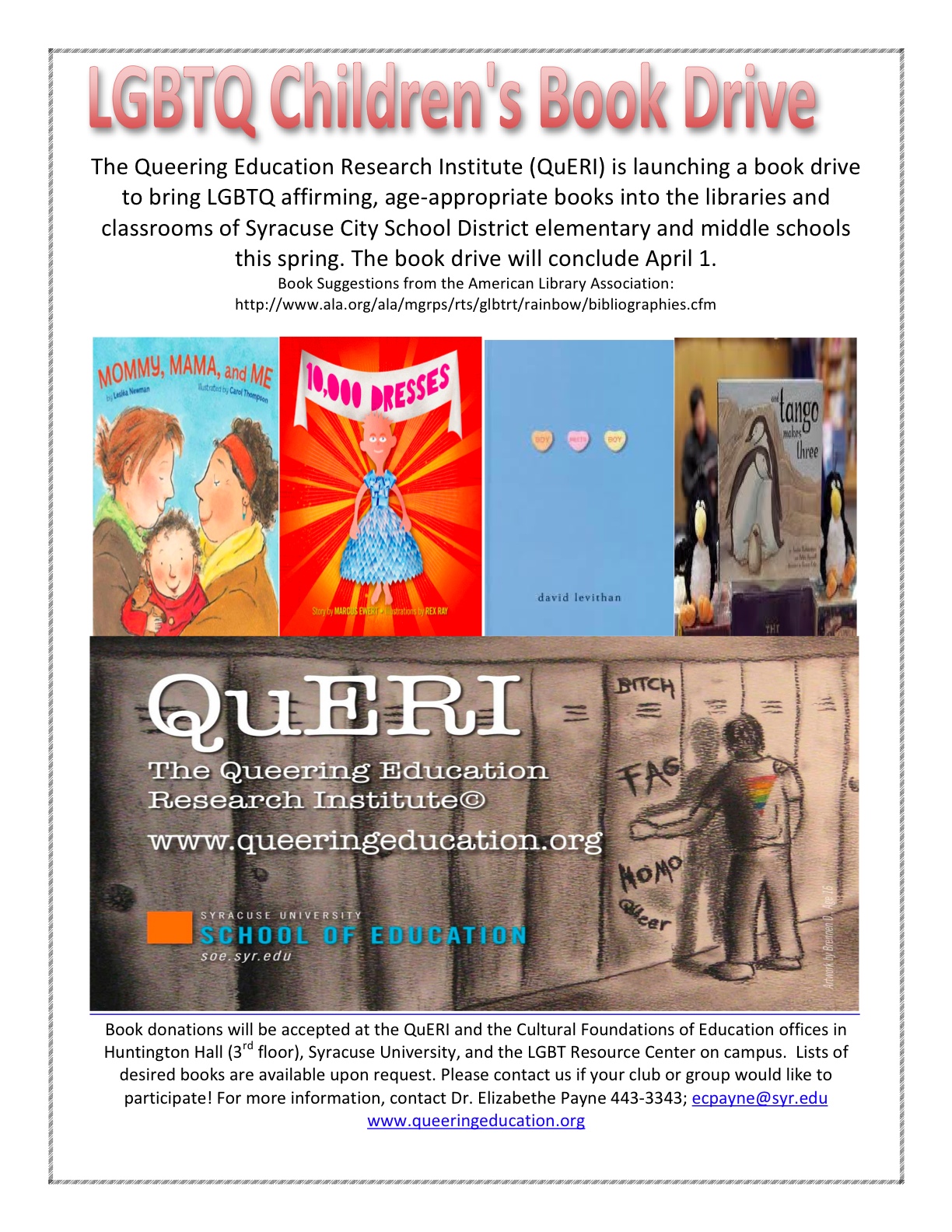
Graduate Student Round Table, April 1, 2011
Please RSVP By March 28.

Lesbian, Gay, Bisexual, Transgender, and Queer students struggle every day to find a place where they can feel comfortable being who they are. Every day LGBTQ high school students are bombarded with homophobic epithets. As the recent string of suicides has shown us, many LGBTQ students feel the only way to escape their school experience is death.
Help make this reality something of the past.
Syracuse University students have compiled a report based on sociological research and interviews that they have conducted with individuals involved in local Syracuse area schools. This report discusses the position of LGBTQ students in these schools and how to possibly help change the current school climate.
Please come to the presentation of this report on Monday the 13th of December at 1:00pm. We will be presenting in room 011 of the Martin J. Whitman School of Management Building at 721 University Ave on the Syracuse University campus. Your presence will be greatly appreciated.
Light refreshments will be served.
Please RSVP to:
Cultural Foundation of Education department at 315-443-3343
Katherine Seiger
Paper Title: An Exploration of Heternormativity in Sex Education Curricula
Abstract: Between 2000 and 2009, conservative US government control over sex education dramatically increased. This control can be categorized into three areas: control over dissemination of sex and sexuality information; control of federal funding for sexuality education and research (Irvine, 2004) and control over what “counts” as legitimate sexual expression: heterosexual intercourse. From 1988 to 2003 the percentage of public school teachers utilizing abstinence only curriculum with no information on condoms or contraception escalated 28% (Irvine, 2004), and in 2003 the National Institutes of Health increased scrutiny of federally funded research around same-sex sexual behaviors and HIV prevention in response to conservative claims that these were a “waste” of public funding. This cultural re-entrenchment in heteronormative sexuality further distanced LGBTQ youth from the possibility of comprehensive, accurate, non-stigmatizing sexual education. Continuing to the present, the United States has seen a consistent rise in the number of HIV and STI cases in youth—the largest concentration in young men who have sex with men. In an effort to better understand the heteronorms that inform sex education, four popular curricula were explored using textual analysis. The review suggests that heteronormative messages and assumptions underlying sexuality education impede efforts to empower youth sexual health in general, and LGBTQ identifying youth sexual health specifically. Furthermore, both gendered messages and fear tactics serve to marginalize and disengage LGBTQ youth. Implications for development of an LGBTQ youth affirming curricula are discussed.
Elizabethe Payne & Melissa Smith
Paper Title: Safety and Gay Day: The Limits of Safe Schools and Inclusion Discourses in Creating Affirming Environments for LGBTQ Students.
Abstract: Research has explored multicultural teacher education from multiple, sometimes divergent perspectives, yet these studies agree that what passes for multicultural teacher preparation is often “ not multicultural at all” and retains a focus on “celebrating diversity or understanding the cultural ‘other’ rather than a commitment to educational equity” (Gorski, 2009, p. 309). Interviews conducted with RSIS participants indicate that though the training utilizes a critical approach, what teachers embraced from the workshop was a call to understand and “protect” students harassed for gender or sexual identities through the “safety” discourse –a form of understanding and valuing the “cultural other”—and an investment in one time visibility events like participation in the annual Day of Silence as a symbol of improved school climate. Additionally, we found that educators frame LGBTQ issues as “risk” issues rather than as equity issues. These frames of thinking – safety from bullying; noting days of recognition highlighting school bullying and silencing, disease, and murder; and grouping LGBTQ issues with risky behaviors—continue to mark LGBTQ students as “victims” or “problems” in need of saving or solving. We posit that participant responses to the RSIS workshop content reflect educators’ understanding of their obligation to “diversity” as presented during their teacher preparation programs and that workshop content which resonated with them was that which they could easily fit into these familiar frameworks.
Panel Title: No ‘Gay’ Left Behind: Exploring Multiple Points of Exclusion and Possibilities for Change in the School Lives of LGBTQ Youth, American Education Studies Association (AESA), Denver, CO: 2010
Abstract: For LGBTQ students, school can be a battleground where attempts to define themselves—through dating, academic work, or experimentation with self-expression—are regulated by cultural systems that stigmatize identities that transgress hegemonic gender norms. The social scene, curriculum, extra curricular activities and policy all contribute to school climates where “successful” performance of masculinity and femininity are rewarded and non-conformity is punished through silencing and exclusion. This panel aims to explore the complicated problem of creating more affirming environments for LGBTQ students by examining sites in which LGBTQ identities continue to be marginalized—sex education curriculum—as well as avenues for possible change—teacher training and policy reform. Collectively, these papers address the need to expand the definition of the “problem” of unsupportive schools beyond issues of violence and discrimination and toward comprehensive understanding of the cultural systems that persistently marginalize LGBTQ youth.
ABSTRACT: In 2009, QuERI offered its first cultural competency training to youth service providers in CNY. Informal research conducted prior to the training indicated that there was little awareness among youth service providers of the experiences or needs of LGBTQ youth. Many participants in the workshop revealed that their agencies had not addressed the issue and they were unaware of the statistical likelihood of disproportionate representation of LGBTQ youth in their services. This study will explore the awareness and LGBTQ cultural competence of youth service providers in CNY.
Data collection to begin late Fall 2010.